- Aileron
- Ailerons are movable control surfaces found on the trailing edge of both the right and left wings of a plane. Each surface moves in the opposite direction to enable the plane to roll right or left. For a plane to roll left, the left aileron moves upward (destroying some lift on that wing) while the right aileron moves downward (increasing lift). This unequal lift causes the plane to bank and turn. In German, ailerons are called Querruder — useful when reading those German kit instructions!
 Diagram showing the main control surfaces of a typical R/C sailplane.
 - Ailevator
- A relatively modern term that has started to be used in models with computer radio systems. An ailevator is where each elevator half on a conventional or V-tail moves independently, like ailerons on a wing. In addition to both elevator halves moving up and down together for pitch control, each side can move in opposite directions to provide roll control. On a V-tail, this is also known as a ruddervator. Typically, both ailevators and ailerons are coupled together via the transmitter to maximize roll performance, especially on larger wingspan planes.
 Each elevator half moves independently for combined pitch and roll control.
 - AM (Amplitude Modulation)
- Early radio transmission method. Cheaper but more prone to interference than FM. Largely obsolete. See Radios.
- AMA (Academy of Model Aeronautics)
- The premier US model aviation organization. Provides up to $1,000,000 liability insurance, lobbies for hobbyist interests, and administers contests. Many flying fields require AMA membership. modelaircraft.org
- ARF (Almost Ready to Fly)
- Kit requiring minimal assembly — major components pre-built, needing final assembly and radio installation. (Most ARF's are really not ready and require some head-scratching to get the plane finished.)
- Aspect Ratio
- Wing span divided by chord. Higher ratios (long, skinny wings) have less drag — why gliders have such long wings.
- BEC (Battery Eliminator Circuit)
- A BEC is a voltage regulator that powers the receiver and servos from the main flight battery, usually providing 5V, 6V, or sometimes a selectable higher voltage for HV radio gear. In electric sailplanes the BEC is often built into the ESC, which saves weight by eliminating a separate receiver battery. The important detail is current capacity: a small foam glider with two micro servos may be fine on a modest BEC, while a full-house sailplane with flaps, ailerons, rudder, elevator, and digital servos can overload an undersized unit. For larger or more valuable gliders, pilots often use a higher-quality switching BEC, a separate receiver pack, or redundant power setup to prevent radio brownouts.
- BNF (Bind and Fly)
- Plane with receiver installed, ready to bind to a 2.4 GHz transmitter and fly.
- Brushless Motor
- A brushless motor uses electronic switching instead of physical brushes to commutate the windings, which means no wearing contacts, less heat, higher efficiency, and a much longer service life than a brushed motor. Brushless motors require an ESC to drive the three-phase windings in the correct sequence. In R/C they are the standard choice for the main propulsion motor on electric sailplanes and powered models, where their high power-to-weight ratio and reliability matter most. They are not typically found inside servos, however — the small DC motors driving the gear train of an R/C servo are almost always brushed, either of the cored or coreless type. A handful of premium servos do use brushless motors for even higher precision and longer life, at a significant cost premium.
- Carbon Fiber
- Ultra-strong fibers woven into mats or cast into rods, used for high-strength wings and structures. Stronger than fiberglass or Kevlar when used correctly.
- CA (Cyanoacrylate)
- Fast-setting glue popular in R/C. Different formulas: thin, thick, foam-safe. Some can cause allergic reactions — see CA Sensitivity. More: Adhesives Guide.
- CG (Center of Gravity)
- The balance point of a plane. Some planes such as Handlaunch (HLGs) are very CG-sensitive — moving the CG as little as 1/16" can matter. Typically balanced at the main spar. See Decalage.
 Balancing a glider on your finger tips.
 - Cardiac Hill
- What you climb after being 'killed' in combat — gasping for oxygen all the way up, for the 50th time.
- Chord
- Distance from wing leading edge to trailing edge in the direction of airflow. Related to aspect ratio and MAC.
 Chord in relation to Wingspan.
 - Clevis
- Clevises are small clips used to connect push rods to servos or to movable control surfaces such as ailerons, rudder, or elevator. They come in different materials — plastic, nylon, and metal. For combat and heavier-duty use, the black metal ones (Kwik-Links) are recommended, with a small piece of plastic straw slid over the link as a "keeper" to prevent it from opening during a combat collision.
 Common clevis styles used in R/C sailplanes.
 - Composite
- Composite construction combines materials such as fiberglass, carbon fiber, Kevlar/aramid, epoxy resin, balsa, and foam cores so each material does what it does best. In R/C sailplanes, composite wings and fuselages can be extremely stiff, smooth, and light, which improves energy retention, launch height, and penetration in wind. A molded composite ship may use carbon spars or skins for stiffness, fiberglass for smooth outer surfaces, and Kevlar in areas that need toughness. The trade-off is cost and repair complexity: composites can be very strong in normal flight loads, but damage from a hard landing or mid-air collision may require careful sanding, cloth layup, epoxy work, and alignment.
- Control Horn
- A control horn is the small lever mounted on a movable control surface such as the rudder, elevator, aileron, or flap. A clevis or pushrod attaches to one of the holes in the horn, allowing the servo to push or pull the surface. The hole position changes the mechanical advantage: using a hole farther from the hinge line gives more leverage and finer control, while a hole closer to the hinge line gives more surface movement but less force. Good setup practice is to mount the horn so the linkage is square to the hinge line at neutral, with no binding and as little slop as possible. On sailplanes, clean linkages matter because even small amounts of slop or drag can affect trim, launch behavior, and precision landing control.
- Cored Motor (Iron-Core)
- A cored motor is the traditional small brushed DC motor used inside the vast majority of R/C servos. The rotor is built around an iron (laminated steel) core with copper wire wound onto it, spinning between the permanent magnets of the stator. The iron core makes the motor cheap to manufacture and gives strong torque for its size, which is why analog and budget digital servos almost universally use them. The trade-offs come from the iron itself: the rotor has noticeable inertia, so the motor accelerates and stops more slowly, response is a touch less crisp, and there is a small amount of "cogging" — a slight stepping feel as the rotor passes each magnet pole, which can be felt as tiny stutters when holding a control surface against load. They also draw more current at stall and run hotter than coreless types under heavy load. For most sport and beginner sailplanes — handlaunch trainers, slope ships, foam combat — cored servos are perfectly adequate and offer the best torque per dollar. Compare with coreless servo motors, and with the brushless motors used for main propulsion. See The Gigantic Servo Chart.
- Coreless Motor
- A coreless motor replaces the iron core of a traditional brushed DC servo motor with a self-supporting "basket" of copper windings, eliminating the iron rotor entirely. Without the heavy iron core, rotor inertia drops dramatically, and the motor can change direction almost instantly with no cogging, no stepping, and very smooth low-speed control. The result inside a servo is faster transit times, sharper centering, less current draw at hold, and a noticeably more precise feel — the qualities that matter for high-end thermal duration ships, F3F slope racers, and aerobatic models where a sloppy hold or laggy correction shows up immediately in the air. The disadvantages are cost (coreless servos run roughly 1.5–3× the price of a comparable cored servo), slightly lower peak torque for the same physical size, and reduced tolerance for sustained stall current — the thin coreless windings have less thermal mass and can burn out faster if the servo is left binding against a stuck control surface. Many premium digital servos pair a coreless motor with metal gears and a dual ball-bearing output for a top-tier setup. Note this is still a brushed motor — it is not the same thing as a brushless motor, which uses electronic commutation and is more commonly found driving the main propeller rather than a servo. Compare with cored servo motors. See The Gigantic Servo Chart.
- Coroplast
- Corrugated plastic material — tough, flexible, lightweight. Great for stabilizers on combat planes. Comes in various colors.
 Colorful Coroplast corrugated plastic sheets.
 - Decalage
- Angle between wing and horizontal tail surface. Affects pitch trim. See About Decalage.
- Dihedral
- Dihedral is where the right and left wing tips are higher than the fuselage. More dihedral generally means the plane will be more stable in the air, but harder to turn aerobatically. For planes with only rudder and elevator controls (no ailerons), dihedral is a necessity — it's what makes the rudder produce banking turns. When a wing has more than one panel at different angles, it's called polyhedral.
 Dihedral angle — wing tips higher than fuselage for stability.
 - DLG (Discus Launch Glider)
- A specialized category of unpowered gliders launched by spinning 360 degrees and throwing the model by a "peg" on the wingtip, reaching high altitudes without a motor. See handlaunch sailplanes.
- Drag
- Drag is the aerodynamic resistance that slows the model as it moves through the air. For sailplanes, drag is especially important because there is no engine producing continuous thrust; every bit of unnecessary drag costs altitude, speed, or glide distance. Drag comes from several sources, including skin friction over the wing and fuselage, form drag from bulky shapes, induced drag created while the wing makes lift, and extra drag from exposed linkages, open gaps, antennas, or a windmilling propeller. Many glider design choices — long high-aspect-ratio wings, smooth covering, folding propellers, sealed hinge gaps, and clean control linkages — are intended to reduce drag and improve glide performance.
- Elevator
- The elevator is the horizontal control surface on the tail of a plane that controls pitch — the nose moving up or down. When the elevator surface moves upward, the tail is pushed down and the nose pitches up, and vice-versa. You want to connect your radio so that pulling back on the stick makes this surface move upward (nose up). Without an elevator, controlling the altitude of a plane is nearly impossible. The German word for elevator is Höhenruder (high-rudder).
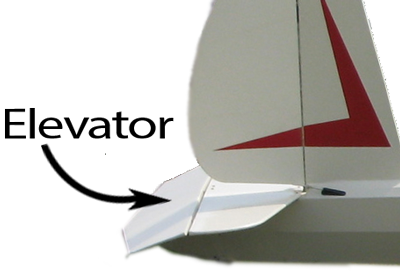 The elevator controls pitch — nose up and down.
 - Elevons
- Elevon means both aileron and elevator combined as the same control surface. Elevons are typically used on tailless aircraft such as flying wings. Like ailerons, elevons provide roll control by moving in opposite directions; like an elevator, they provide pitch control by moving up and down together. In order for a plane to have elevons, either a computer R/C system or a mixer (electronic or mechanical) is needed. This movement is very similar to what happens in a V-Tail setup.
 Elevons combine roll and pitch control on a flying wing.
 - Epoxy
- Resin+hardener adhesive. Sets in 5 or 30 minutes. See Adhesives Guide.
- EPO (Expanded PolyOlefin)
- Stiff, durable foam. Standard CA works on it without melting, unlike EPS.
- EPP (Expanded Polypropylene)
- Flexible, rubbery foam — bends and bounces from impacts. Used in combat and trainer planes. Glue this foam with hot-melt, shoe-goo, or epoxy adhesives.
- EPS (Expanded Polystyrene)
- White foam (coffee cups, packing). Sensitive to solvents — standard CA melts it. Use foam-safe CA or white glue on this kind of foam.
- ESC (Electronic Speed Controller)
- An ESC is the electronic unit that controls the speed of an electric motor from the throttle signal sent by the receiver. In electric sailplanes, the ESC is usually used for short climb bursts rather than continuous powered flight, so reliability and correct setup are more important than simply choosing the highest current rating. Many glider ESCs include a brake setting that stops the motor when the throttle is off, allowing a folding propeller to fold back against the fuselage and greatly reduce drag. ESCs may also include a built-in BEC to power the receiver and servos, plus settings for battery type, low-voltage cutoff, timing, soft start, and brake strength. Always size the ESC for the motor, propeller, and battery combination, because an over-propped motor can draw far more current than expected.
- Flapperon
- A flapperon is a control surface that works as both an aileron and a flap. Each wing panel has its own servo so the surfaces can move opposite directions for roll control, then both can droop together to act like flaps. On R/C sailplanes, flapperons are often used to slow the model for landing, increase camber for thermal flying, or reflex the wing slightly for better speed and penetration. They are not quite the same as dedicated inboard flaps because the entire aileron moves, so too much flap deflection can reduce roll authority or make the model feel "mushy" in the air. A computer radio is normally used to mix flap, aileron, elevator compensation, and flight modes.
- Flaps
- Trailing edge surfaces that move down to increase lift and slow your plane down for landing. The flaps are located inboard of ailerons, closer to the fuselage. Some sailplanes will combine the action of flaps with ailerons in the same motion. These are known as flapperons.
 Flaps (inboard) and ailerons (outboard) on a sailplane wing.
 - FM (Frequency Modulation)
- FM was the dominant R/C radio transmission method for many years before modern 2.4 GHz spread-spectrum systems became common. Compared with older AM radios, FM provided better resistance to electrical noise and interference, which made it popular for sailplanes, sport models, and competition flying. Traditional FM systems used fixed frequency channels, so pilots had to manage frequency pins or channel boards at the field to avoid two transmitters on the same channel. Many excellent 72 MHz FM radios still exist, but most new pilots now choose 2.4 GHz equipment because binding, model memory, telemetry, and freedom from frequency conflicts are far more convenient. See Radios.
- Full-House
- A full-house sailplane is one with the complete set of independently-controlled flying surfaces: separate ailerons, flaps, rudder, and elevator — typically six servos in total (one per aileron, one per flap, plus rudder and elevator). This level of control unlocks the full range of sailplane techniques: precise thermal circling with camber-changing flap presets, fast cruise with reflex (flaps slightly up), and powerful crow/butterfly braking on landing where flaps deploy down while ailerons rise up to spill lift on the spot. A computer transmitter with at least 6 channels and multiple flight modes is mandatory, and the same transmitter handles all the mixing — flap-to-elevator compensation, aileron differential, snap-flap, and aileron-to-rudder coupling. Setup is involved: matching servo travel between the two ailerons and two flaps, sealing hinge gaps for clean flow, and balancing the model carefully. Full-house ships are not for first-time pilots, but they are what most competition F3J, F3B, F3F, and thermal duration sailplanes use. Not for beginners! See Full-House Wiring.
 Full-house sailplane showing control surfaces.
 - Gold-N-Rod
- Tradename flexible pushrod system by Sullivan — plastic outer sleeve with sliding nylon inner rod.
- Hi-Start
- A hi-start is a length of rubber elastic material (such as surgical tubing) connected to a length of nylon or other cord. Hi-starts are usually constructed of several hundred feet of surgical rubber tubing connected to an even longer piece of line (typically twice as long) — either braided nylon cord or monofilament (fishing line). One end of the rubber is staked into the ground and the other end (the cord end) has a ring fastened to it. The ring slips over a tow-hook on the bottom of the sailplane (just in front of the CG). You stretch the hi-start a considerable distance downwind, then release the plane into the wind. The elastic tension launches the sailplane to impressive heights with minimal effort.
 A hi-start stretches rubber tubing and line to catapult the sailplane skyward.
 - Kevlar (Aramid)
- Very strong synthetic fiber by DuPont. Typically for fuselages and wing reinforcement similar to carbon fiber.
- Kwik-Link
- Kwik-Link is the trade name for a metal clevis that is very popular in R/C modeling. The metal clevises are strong and have very little flex when installed properly. These are my preferred type of clevis for combat and other high-stress applications versus using nylon clevises. A small piece of plastic tubing, metal clip, or section of drinking straw acts as a "keeper" to prevent the link from opening under impact.
 Metal Kwik-Links with keepers — strong and reliable for combat use.
 - Li-Ion (Lithium Ion)
- Cell-based rechargeable battery. 2-cells = 7.4V — can damage non-6V-rated receivers without a voltage regulator! See also rechargeable batteries.
- LiFe (Lithium Iron Phosphate - LiFePO4)
- Safer lithium chemistry than LiPo. 2-cell = 6.6V — better for receiver packs. Won't catch fire from air exposure due to damage. See also rechargeable batteries.
- LiPo (Lithium Polymer)
- Lightweight rechargeable battery with similar chemistry to Li-Ion batteries. 2-cells = 7.4V — can damage non-6V-rated receivers without a voltage regulator! See also rechargeable batteries..
- MAC (Mean Aerodynamic Chord)
- MAC means Mean Aerodynamic Chord: the representative chord of a wing, especially useful when the wing is tapered, swept, or has multiple panels. Instead of guessing the center of gravity from the root chord alone, designers and pilots use the MAC to choose a starting CG location that better represents the whole wing. A common starting point is around 25% to 33% of the MAC measured back from the leading edge, depending on the design and desired stability. For sailplanes, small CG changes can noticeably affect launch, thermal circling, penetration, and stall behavior, so MAC is a useful reference when setting up a new model or comparing different wing planforms.
- Mixer
- A mixer combines two or more control channels so that one stick or switch input drives multiple control surfaces in a coordinated way. The most common R/C examples are V-tail mixing (one stick input drives both ruddervators), elevon mixing (aileron + elevator drive both elevons on a flying wing), and flaperon mixing (one channel of flap drives both aileron servos down together). More advanced sailplane mixes include aileron-to-rudder coupling for cleaner turns, flap-to-elevator compensation to prevent the nose from rising when flaps deploy on landing, and crow/butterfly braking that drops both flaps and raises both ailerons simultaneously. In the old days, mixers were small mechanical or electronic boxes wired between the receiver and servos, but in any modern computer transmitter, mixing is done in software with adjustable rates, offsets, and master/slave channel assignments. See V-Tails & Elevons.
- Mode I & II
- Radio control transmitters are available in two main configurations. Mode II (standard in North America): the left stick controls throttle (if any) and rudder, while the right stick controls elevator and aileron. Mode I (common in Europe): the left stick controls elevator and aileron, while the right stick controls throttle and rudder. Most sailplane pilots in the USA use Mode II. If you're just starting out, go with whatever is standard in your region — switching modes later is very difficult!
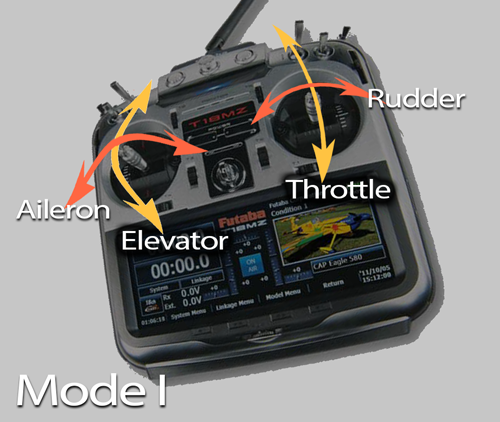 Mode I stick assignments.
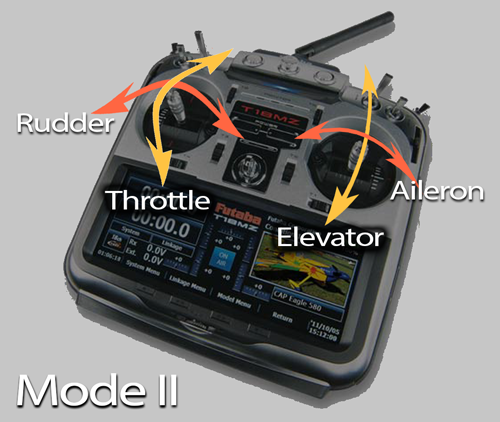 Mode II stick assignments.
 - Model Memory
- Transmitter feature storing separate settings for multiple planes. Switch between models without reprogramming.
- NiCad (Nickel-Cadmium)
- Rechargeable battery. 1.2V per cell. Hundreds/thousands of recharge cycles. Being replaced by LiPo/LiFe. See also rechargeable batteries.
- NiMH (Nickel Metal Hydride)
- Higher capacity than NiCad at similar weight and voltage, but higher internal resistance can cause voltage drops under load. Safer to charge than lithium. See also rechargeable batteries.
- Open Class
- Large wingspan, high-performance sailplanes (100"+). See Open Class listings.
- Oxygen
- What you gasp for after climbing Cardiac Hill retrieving your downed combat plane.
- PCM (Pulse Code Modulation)
- Digital form of FM. Data sent as digital pulses rather than analog. Heavier receivers. See Radios.
- Pitcheron
- A pitcheron is a model, usually a slope sailplane, where the wing panels pivot together to provide pitch control instead of using a conventional moving elevator. When both wings rotate the same direction, the model pitches up or down. Pitcherons are often combined with wingeron control, where the same pivoting wing panels can also move opposite directions for roll. This arrangement can make a very clean airframe with fewer exposed control surfaces, but it requires a strong wing pivot mechanism, precise servo setup, and careful mixing. Because the whole wing changes angle, pitcheron models can be very responsive and are generally better suited to experienced pilots.
- PNP (Plug 'n Play)
- A Plug and Play model is a nearly completed R/C aircraft that includes the airframe, motor, ESC, and servos pre-installed. To fly, the user must provide their own compatible transmitter, receiver, & flight battery (and charger).
- Polyhedral
- Polyhedral describes a wing that has two or more separate wing panels on each side, each at a different dihedral angle. Planes with polyhedral wings are typically more stable and more forgiving in most flying conditions, at the expense of being less maneuverable. This design is common in handlaunch sailplanes and beginner planes where stability is valued over aerobatic ability.
 Polyhedral wing with multiple dihedral breaks for enhanced stability.
 - Push Rod
- Rod connecting a servo to a control surface via clevises. Can be wire, carbon rod, or Gold-N-Rod flexible type.
- RCSE
- Radio Controlled Soaring Exchange — a mailing list connecting R/C soaring enthusiasts worldwide.
- Receiver (Rx)
- The receiver is the small electronic unit installed in the plane that picks up the radio signal from the transmitter, decodes it, and sends position commands to each servo and optionally a ESC for driving a propeller. Receivers are matched to the transmitter's protocol — older 72 MHz FM and PCM systems, or any of the modern 2.4 GHz spread-spectrum protocols (FHSS, DSSS, DMSS, AFHDS, FASST, ACCESS, and more). With 2.4 GHz gear, the Tx and Rx are "bound" once with a unique pairing code so they only talk to each other, eliminating the frequency conflicts that plagued the older bands. Receivers come in a wide range of sizes and channel counts: tiny 4-channel micros for park-flyers and handlaunch sailplanes, all the way up to 8–16+ channel units for full-house ships with flaps, ailerons, rudder, elevator, retracts, and motor. Better receivers offer dual or remote antennas (true diversity reception) for reliable signal in deep-fuselage molded gliders, telemetry feedback (RSSI, pack voltage, altitude, vario), and failsafe settings that put the surfaces and throttle into a safe position if the signal is lost. Power them only with the voltage they are rated for — many older receivers cannot handle the 7.4 V from a 2-cell LiPo directly and need a regulator or BEC. See Radios.
- RTF (Ready To Fly)
- Mostly or fully assembled — just add radio (or sometimes nothing at all). See also ARF.
- Rudder
- The rudder is the vertical control surface on the tail that moves left and right to yaw the plane. Moving the rudder to the left causes the tail to swing right, turning the nose left. On simpler 2-channel planes (rudder and elevator only), the rudder works together with dihedral in the wing to produce banking turns. Many sailplanes — especially handlaunch and beginner planes — fly beautifully with just rudder and elevator control. The German word for rudder is Seitenruder.
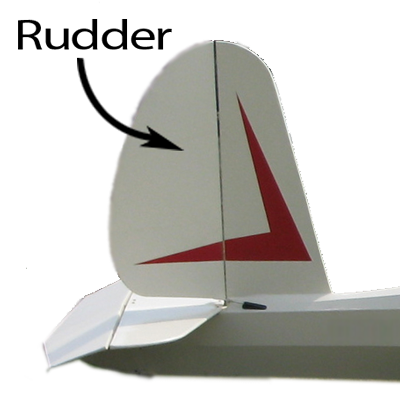 The rudder provides yaw control — turning the plane left and right.
 - Ruddervator
- Combined rudder+elevator surfaces on a V-tail. See V-Tails & Elevons.
- Servo
- A servo is a small electromechanical device containing a motor, gears, and a feedback circuit that moves control surfaces in response to signals from the transmitter via the receiver. Servos come in many sizes — standard, mini, micro, sub-micro, and nano — with varying torque, speed, and weight characteristics. Choosing the right servo for your application is critical: lightweight servos for handlaunch, strong/fast servos for combat, and high-precision digital servos for competition flying. See Servo Wiring for connector details and The Gigantic Servo Chart for comparisons of 900+ servos.
 A digital R/C servo with output arm and connector cable.
 - Spoileron
- Aileron that moves upward to spoil lift. With computer radios, easily combined with flapperon function.
- Spoiler
- Surfaces that 'spoil' lift for landing precision or altitude reduction. Can be dedicated plates or spoilerons. German: Landeklappen.
 Raised Spoilers on a sailplane.
 - Spread-Spectrum
- Modern radio technology using frequency-hopping across 2.4 GHz. Each Tx/Rx pair has a unique pattern — no frequency conflicts. Types: FHSS, DSSS, DMSS, AFHDS, FASST, ACCESS, and more. See Radios.
- T-Tail
- A T-Tail is a tail configuration where the horizontal elevator is mounted on top of the vertical rudder fin, forming a "T" shape when viewed from the front. This design is common on sailplanes and commercial jets because it places the elevator up out of the turbulent wake of the wing, giving cleaner airflow and more effective pitch control. It also makes the elevator less likely to break during hard landings since it's elevated above ground level. On sailplanes with a single main wheel, a T-tail provides crucial ground clearance that a low-mounted tail would not. The trade-off is that the rudder must be strong enough to support the elevator's weight and aerodynamic loads.
 T-Tail — elevator mounted on top of the rudder.
 - Thermal
- Column of rising warm air used to gain altitude. Can be small puffs or powerful columns. The art of finding and riding thermals is one of the cores of the hobby.
 Diagram of air flow in a thermal.
 - Torque
- Force × distance. For servos: measured in oz-in or kg-cm. Convert: divide oz-in by 13.9 = kg-cm. Weight Converter.
- Transmitter (Tx)
- The transmitter is the handheld radio controller that the pilot uses on the ground. It contains two control sticks (see Mode I & II), various switches and knobs, and — in modern computer radios — a programmable processor with an LCD screen and model memory. Transmitters range from basic 2-channel units to sophisticated 24+ channel systems capable of complex mixing, multiple flight modes, and telemetry feedback. Modern transmitters use spread-spectrum 2.4 GHz technology, eliminating the frequency conflicts that plagued older AM and FM systems. See Radios and Radio History for more details.
 A modern R/C transmitter — the pilot's primary control interface.
 - Triple Taper
- A triple taper wing has three different leading-edge sweep angles along each wing panel, creating a planform that's a compromise between a crescent wing (best aerodynamic efficiency, but very difficult to build) and a simple single-taper wing (easy to build, but less efficient). The triple taper approximates an elliptical lift distribution — the ideal for minimizing induced drag — while still being practical to construct from straight-edged panels. Many high-performance competition sailplanes use triple or even quadruple taper wings.
 Triple taper wing — three sweep angles approximate an elliptical planform.
 - V-Tail
- A V-Tail is a tail configuration where two control surfaces are mounted in a V-shape, combining the functions of both rudder and elevator into a single pair of surfaces called ruddervators. When both surfaces move in the same direction, they act as an elevator (pitch); when they move in opposite directions, they act as a rudder (yaw). A mixer — either in the transmitter or as a separate device — is required to blend the two control inputs. V-tails produce less drag than a conventional tail (fewer surfaces in the airstream) and look distinctive, but can behave oddly in sharp turns if not properly set up. See V-Tails & Elevons for a detailed explanation with diagrams.
 V-Tail — two surfaces combine rudder and elevator functions.
 - Wingeron
- A wingeron is a model where each wing panel pivots independently to provide roll control, rather than using separate ailerons. One wing changes to a higher angle of attack while the other changes lower, creating the difference in lift needed to roll the airplane. Wingerons are most often seen on slope soarers and aerobatic sailplanes where a clean wing and powerful roll response are desirable. The system is commonly combined with pitcheron mixing so both wing panels can move together for pitch and opposite for roll. The mechanical setup must be very solid: any slop in the wing pivots or linkages can make the model difficult to trim and may become dangerous at high speed.